
How Much Do Pharma Companies REALLY Invest in R&D?

Happy Friday!
Before the weekend starts, here’s a quick newsletter to enjoy with your morning coffee covering:
How much does pharma invest in R&D, top financing updates, and the latest scientific breakthroughs in pharma - and more
How Much Does Pharma Invest in R&D?
If you follow me on LinkedIn (and I know many of you do - I see the stats!), you might have caught my recent post on R&D intensity among publicly traded pharma companies.
R&D intensity = R&D spend as a percentage of revenue.
It typically sits around 19–25% for the big names, with an average of ~21% in 2024.
But many of you asked for REAL ($$$) numbers.
Voilà.
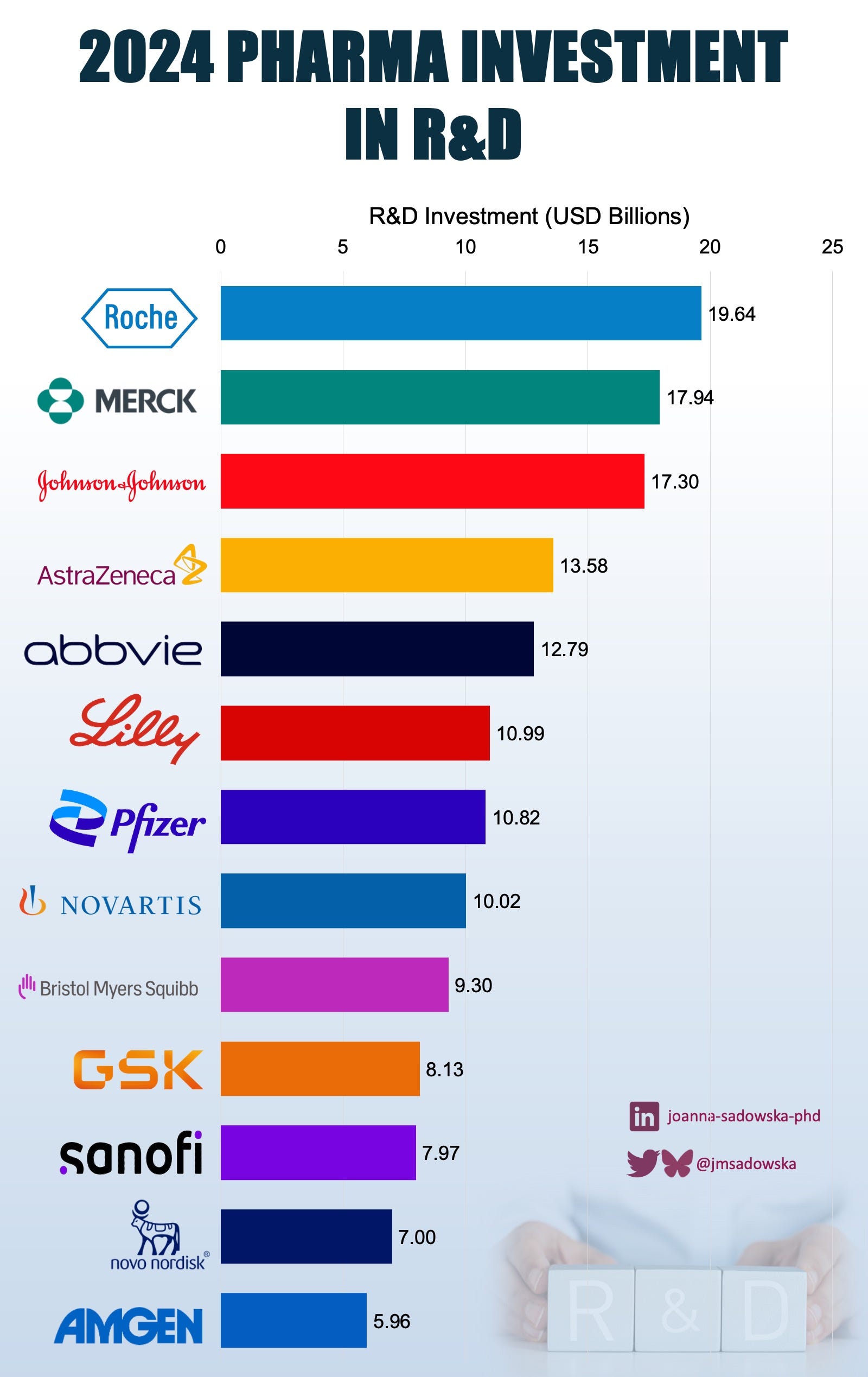
Observations, Suggestions, Take-Home Messages:
Merck and Roche (both around $20B in R&D) are clearly making a massive push in oncology and immunology. Not a surprise here, given that their blockbusters Keytruda and Ocrevus are set to lose patent exclusivity in 2027 and 2028 (more about the patent cliff here).
What was surprising for me was the relatively low R&D investment in Novo Nordisk. It seems that they are far more strategic - having evolved from an insulin company into a GLP-1 powerhouse, where Ozempic and Wegovy now represent major revenue generators. They're currently focused on insulin analogues and projects like IcoSema and CagriSema.
Financing of the Week
Bambusa Therapeutics just smashed their Series A, raising over $90 million in an oversubscribed round led by RA Capital Management.
This Boston-based company develops a bispecific antibody pipeline for immunological and inflammatory disorders.
Two leading candidates are entering or will enter soon Phase I:
BBT001 - a bispecific antibody for a range of undisclosed dermatological conditions.
BT002 - a bispecific antibody for applications across respiratory, dermatology, and gastroenterology.
Science of the Week
CAR T reemission breaks the record.
A woman, treated at age 4, remains in remission 19 years later. This is the longest record yet, demonstrating the real power of engineered immune cells in treating blood cancers.
More here.
Clinical Pipeline of the Week
Every time I hear news about cell and gene therapy, I can’t help but silently sing Britney Spears: “Gimme more, gimme more!”
I’ve got a soft spot for these groundbreaking (and, fortunately, budget-breaking) therapies.
Solid Biosciences is back in the Duchenne muscular dystrophy (DMD) gene therapy game with its next-gen candidate, SGT-003. Phase 1/2 data looks really good—78% of muscle fibres in patients are now dystrophin-positive (FYI, the clinically beneficial target is 40%).
Would they become a competition for Sarepta Therapeutics?
See you next week - Dr Jojo 🌸
Stumbled on my newsletter by accident? Subscribe and stay for longer 👇🏻
Hey Joanna!
Given your interest in Biotech, you might enjoy my recent piece on eXoZymes Inc. They’ve just commercially launched a cell-free enzyme biocatalysis platform that converts biofeedstocks into targeted chemical products.
Plus they just announced their first subsidary which synthesises N-trans-caffeoyltyramine (NCT) to treat MASLD/MASH. Very very interesting compound that has immense potential
https://www.slack-capital.com/p/exozymes-research-report